
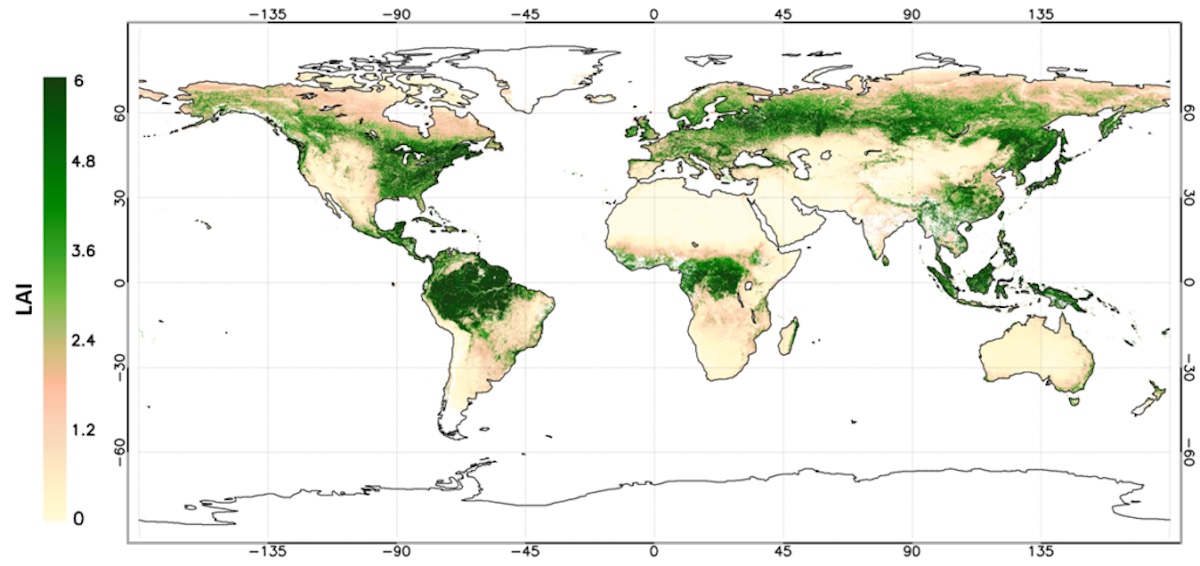
Processor: SNAP-Biophysical
The processor derives vegetation biophysical variables on inversion of top of canopy spectral reflectance values from Sentinel-2 data. The biophysical variables LAI (Leaf Area Index), FAPAR (fraction of absorbed photosynthetically active radiation) and FVC (Fractional Vegetation Cover) can be estimated. Those variables are important input to crop growth models and recognized as essential climate variables (ECVs) by international organizations such as GCOS and GTOS.
The biophysical vegetation variables can be derived from Sentinel-2 data in the Data Explorer using the preconfigured SNAP Biophysical Processor. There, the data is first brought to a common geometric resolution and then the inversion of the spectral reflectance values of the plant canopy is carried out. It is based on the approach described by Weiss et.al. 2000 and implemented in the SNAP toolbox.
Leaf Area Index (LAI)
Leaf Area Index is defined as half the developed area of photosynthetically active elements of the vegetation per unit horizontal ground area. It determines the size of the interface for exchange of energy (including radiation) and mass between the canopy and the atmosphere. This is an intrinsic canopy primary variable that should not depend on observation conditions. LAI is strongly non-linearly related to reflectance. Therefore, its estimation from remote sensing observations will be strongly scale dependent (Garrigues et al. 2006a; Weiss et al. 2000). Note that vegetation LAI as estimated from remote sensing will include all the green contributors, i.e. including understory when existing under forest canopies. However, LAI is not directly accessible from remote sensing observations due to the possible heterogeneity in leaf distribution within the canopy volume. Therefore, remote sensing observations are rather sensitive to the ‘effective’ leaf area index, i.e. the value that would produce the same remote sensing signal as that actually recorded, while assuming a random distribution of leaves. The difference between the actual LAI and effective LAI may be quantified by the clumping index that roughly varies between 0.5 (very clumped canopies) and 1.0 (randomly distributed leaves).
Fraction of absorbed photosynthetically active radiation (FAPAR)
FAPAR corresponds to the fraction of photosynthetically active radiation absorbed by the canopy. The FAPAR value results directly from the radiative transfer model in the canopy which is computed instantaneously. It depends on canopy structure, vegetation element optical properties and illumination conditions. FAPAR is very useful as input to a number of primary productivity models based on simple efficiency considerations (Prince 1991). Most of the primary productivity models using this efficiency concept are running at the daily time step. Consequently, the product definition should correspond to the daily integrated FAPAR value that can be approached by computation of the clear sky daily integrated FAPAR values as well as the FAPAR value computed for diffuse conditions. The instantaneous FAPAR value at 10:00 (or 14:00) solar time is very close to the daily integrated value under clear sky conditions. FAPAR is relatively linearly related to reflectance values, and will be little sensitive to scaling issues. Note also that the FAPAR refers only to the green parts (leaf chlorophyll content higher that 15µg/cm2) of the canopy.
Fractional Vegetation Cover (FVC)
Fractional Vegetation Cover (FVC) corresponds to the gap fraction for nadir direction. FVC is used to separate vegetation and soil in energy balance processes, including temperature and evapotranspiration. It is computed from the leaf area index and other canopy structural variables and does not depend on variables such as the geometry of illumination as compared to FAPAR. For this reason, it is a very good candidate for the replacement of classical vegetation indices for the monitoring of green vegetation. Note that similarly to LAI and FAPAR, only the green elements (leaf chlorophyll content higher than 15µg.cmP -2 P) will be considered.
Access and Use
Depending on the environment and the intended use, there are several ways to apply the processor:
-
EO-Browser: -
-
Data Explorer:
-
Data Catalog: CODE-DE or CREODIAS
Search and select required Sentinel-2 L2A input data -> Add to Workspace -
Go to Workspace - > Select required datasets and Add to processing center -> Go to Processing center
-
Select processor: Sentinel-2: SNAP-Biophysical
-
Select required datasets and parametrize processor (see section below)
-
Create processing order
-
Progress of orders can be monitored in Processing status
-
The processed data will be available in a private S3 bucket or ready for download via the Data Explorer.
-
-
On a Virtual Machine: The SNAP-Biophysical processor is part of the SNAP toolbox, which can be installed by the user or is ready installed within the OSGeoLive image.
In the SNAP toolbox it is fully accessible with all possible outputs available to the user. All Level 2A data products of Sentinel-2 can be used as input. Before the biophysical variables can be extracted from Sentinel-2 data all spectral bands have to be resampled to a common pixel size.
Parametrization of the SNAP-Biophysical processor in Data Explorer
In the Data Explorer input mask the processing order can be specified in more detail by opening the “Edit optional workflow options” menu.
In the first section users can select different data catalog options for input data (all entries starting with “source” or “input”).
Note: Do NOT change this section. Only default settings are operational at the moment!
In the second section (red area in the image below) the output storage and output format can be chosen . The processor output can either be stored in the user’s private S3 storage bucket or a temporary storage space provided by CODE-DE. For the use of S3 Object Storage see also https://knowledgebase.code-de.org/en/latest/s3/s3.html.
In the third section (indicated in blue below) the geometric resolution of the result and the desired output variables can be chosen. For more information consult the reference below and see the SNAP online help at https://step.esa.int/main/doc/online-help/.
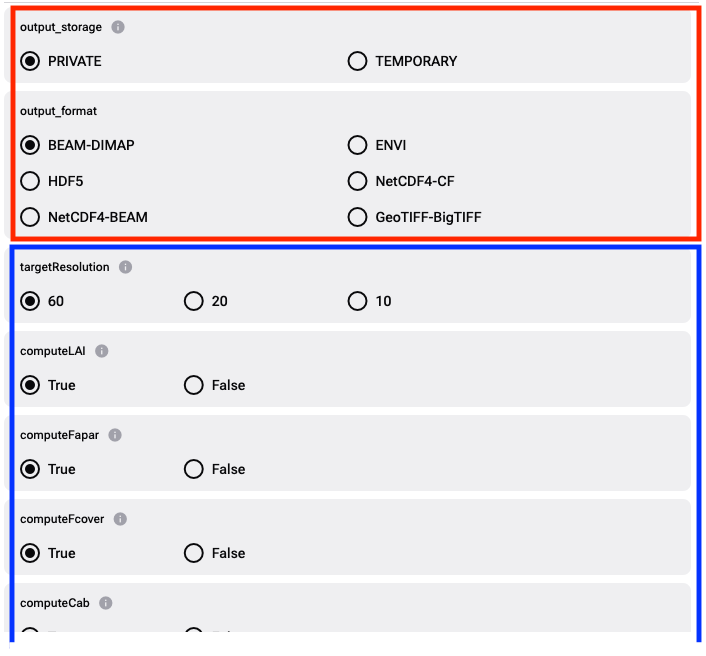
Input mask for the parameters of the SNAP-Biophysical processor
Usage requirements
There are certain requirements that must be met for use. Some data or services require an individual application. For more information, please contact CODE-DE Support.
- Registration on CODE-DE: Yes.
- Cloud resources on CODE-DE: Yes, to store output in private S3 buckets
- Individual request: No.
More information
Further information on this product can also be found on the following pages:
References
The following list of references does not claim to be exhaustive, but it does provide an initial introduction to more advanced specialised literature.
“Investigation of a model inversion technique to estimate canopy biophysical variables from spectral and directional reflectance data”, Marie Weiss, Frédéric Baret, Ranga B. Myneni, Agnès Pragnère and Youri Knyazikhin, Agronomie, 20 1 (2000) 3-22,
DOI: https://doi.org/10.1051/agro:2000105
Terms of use
Use of the product is subject to the following terms of use: