Gebäudedetektion
The project "Building detection on the CODE-DE platform" aims to improve traditional methods for updating building data in the real estate cadastre by using artificial intelligence (AI).
In the past, demolitions and new buildings were often overlooked, so these processes are now to be made more efficient by automatically recognising changes.
Motivation and objectives
In order to reduce the manual effort and speed up the update cycle, AI-based methods will be used to generate so-called change notices. This means that only the detected changes, such as new buildings or demolitions, need to be checked and processed manually. This not only improves accuracy, but also reduces the effort involved in maintaining building data.
Input data
The data basis consists of true orthophotos of the entire city of Gelsenkirchen with three colour channels (RGB, 10 cm resolution) as well as the building data from the real estate cadastre (ALKIS). In order to increase the diversity of the dataset and ensure that different urban structures are covered in the training dataset, the Inria dataset was also integrated. A ratio of 80 % for the training data set and 20 % for the validation data set was observed for the distribution of the data.
In order to increase the performance of the model, the data set is expanded using various augmentation techniques. These include, for example, randomised image sections or changes in brightness and contrast, as well as random rotations and reflections and other methods. These methods increase the diversity of the training data and improve the robustness of the model.
The performance of the model was successfully evaluated in the first subsequent test runs with high-resolution satellite images with a resolution of 30 cm. These tests confirm that the model can also handle other image sources, such as high-resolution satellite images, well.
Our AI model on CODE-DE
Various models were tested as part of the project, including FCDenseNet57 and the SAM model (Segment Anything Model). Although the SAM model provided promising results, it turned out that it is not suitable for off-the-shelf GPUs due to its size during training. To overcome this limitation, the training was carried out on a powerful virtual machine with an A100 GPU in the CODE-DE Cloud. This machine is equipped with 24 vCPUs, 118 GB RAM, 5 TB block storage, 10 TB object storage and an IPv4 connection.
To optimise the model, the Low-Rank Adaptation (LoRA) approach was used, the implementation of which is based on a GitHub repository (Figure 1). Once the building masks have been generated, a comparison is made between the current ALKIS database and the buildings detected by the AI model. This comparison enables differences to be identified and potential demolitions and new buildings to be displayed.
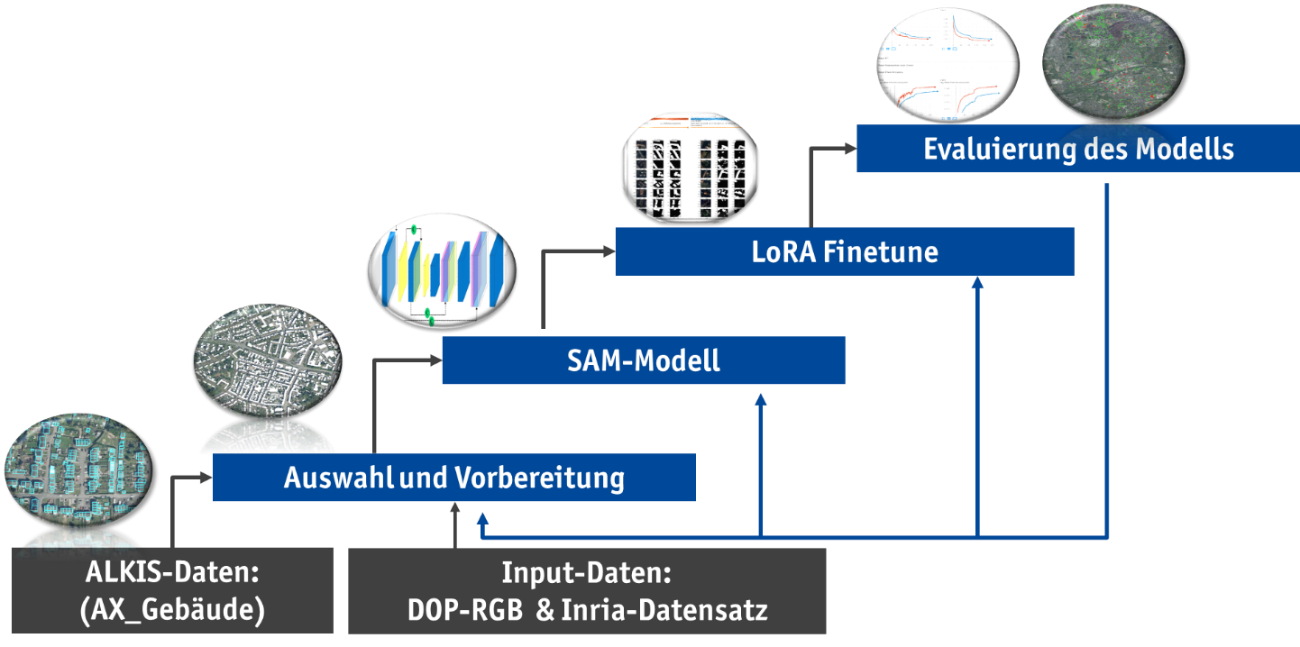
Figure 1: Rough presentation of the workflow for building detection with AI
Results
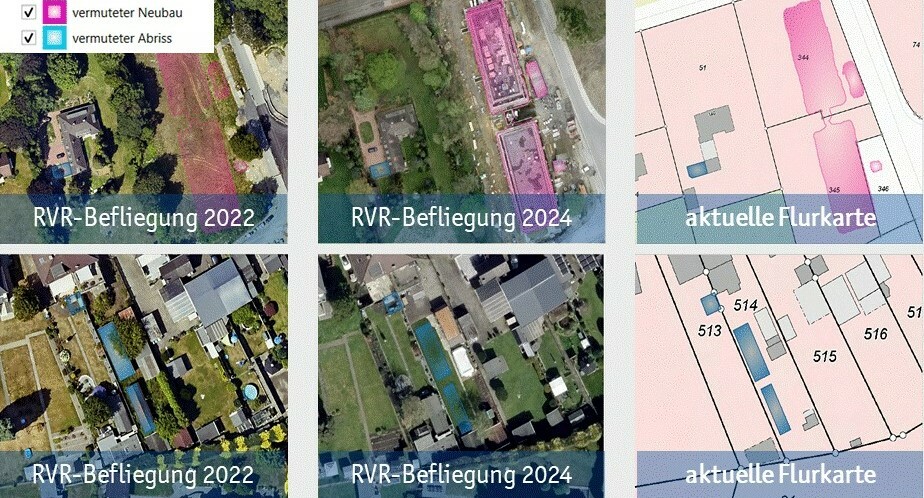
The analysis shows a high degree of correspondence between the results and the real building structures. The AI model was able to successfully identify existing buildings as well as potential new buildings and demolitions. Some examples of the results are listed below:
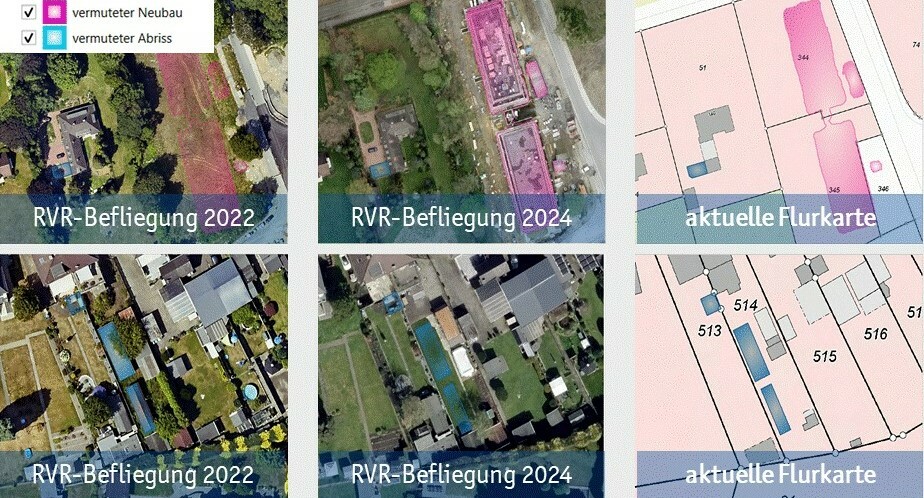
Figure 2
In future, AI-based building detection will be carried out after new data sets, such as aerial photographs or high-resolution satellite images, have been received. The indications of change, such as new buildings or demolitions, are then processed according to technical criteria. A clerk then decides whether to accept or reject the recognised changes. Accepted change notices are then transferred to the property register and updated there. The project shows how AI-based methods in combination with various high-resolution data sources can significantly increase the efficiency and accuracy of updating building data.