KI4KI
Artificial intelligence for climate-resilient infrastructure monitoring
Signs of advancing climate change can be felt all over the world. In Germany, climate change can be seen in the increasing number of extreme weather events. The climatic changes can also put dams under stress, which are subject to seasonal fluctuations due to changes in temperature and reservoir levels.
As part of the BMWK joint project, "KI4KI - Artificial Intelligence for Climate Resilient Infrastructure Monitoring", between the Friedrich Schiller University Jena and the Ruhrverband, an AI-based approach was combined with Persistent Scatterer Interferometry (PSI) methodology to better assess the stress on various dams caused by changing climatic conditions.
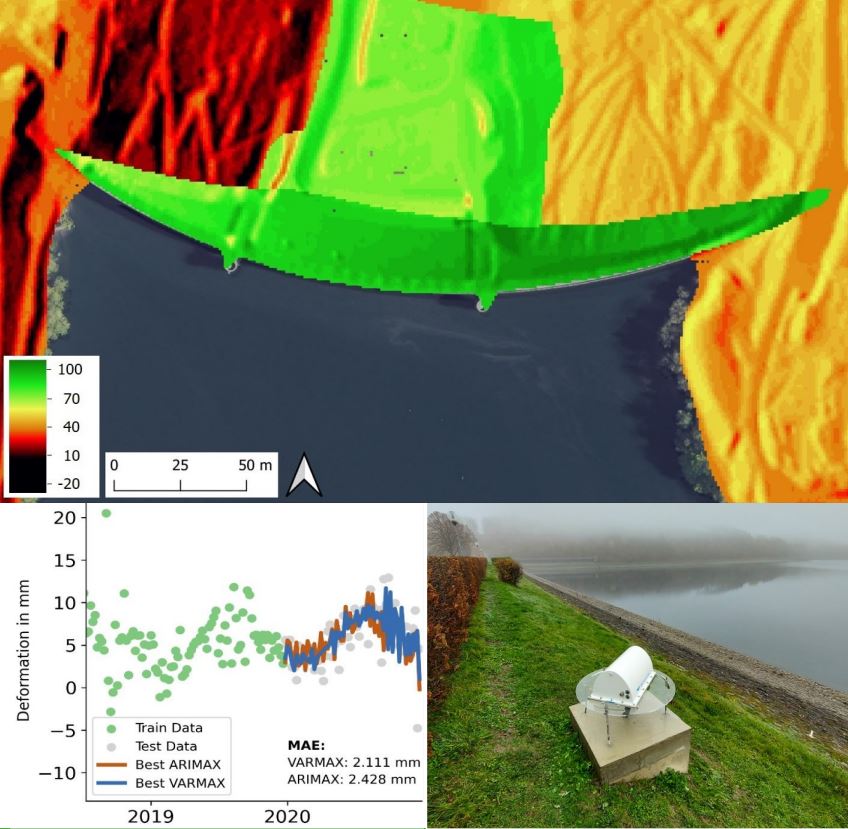
In order to ensure that the Ruhrverband dams to be monitored are also visible in the radar image, new types of instruments - electronic corner reflectors (ECR) - were installed on the walls and dams of the Möhne, Sorpe, Verse, Bigge and Lister dams. In addition, the time series of various satellite sensors were combined (e.g. X- and C-band). The application of this multi-sensor fusion with subsequent segmentation of dam areas enables a spatial and temporal compression of the movement information.
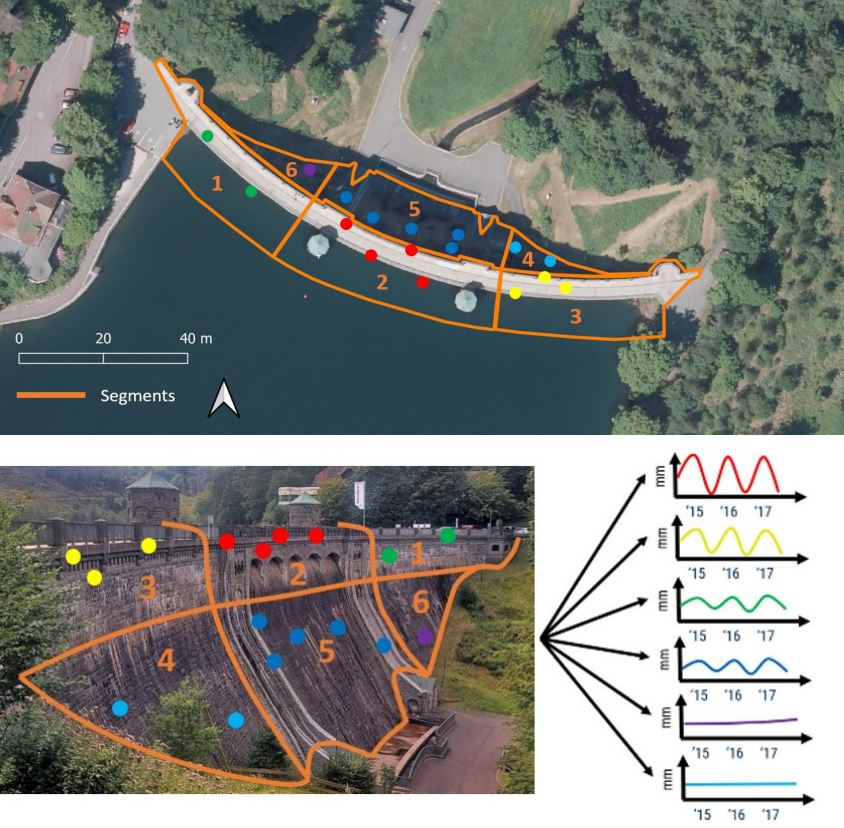
The time series were processed using resources from the EO-lab cloud platform. Using machine learning and deep learning methods, the temperature and water level in the reservoir were identified as the main drivers of the movements. Movement predictions in the event of a change in these parameters can be generated using various models. These advanced approaches open up new possibilities for effective monitoring, risk assessment and protective measures to strengthen the resilience of our infrastructures to environmental impacts.
More detailed information on the project and the relevant contacts can be found under the following links:
- https://www.chemgeo.uni-jena.de/30371/infrastrukturueberwachung-mit-radarinterferometrie
- https://ruhrverband.de/nachhaltigkeit/forschungsprojekte/ki4ki
Current results of the project and descriptions of the procedure are summarized in the following publications:
- Jänichen, J., Ziemer, J., Wolsza, M., Klöpper, D., Weltmann, S., Wicker, C., ... & Dubois, C. (2025). Towards Operational Dam Monitoring with PS-InSAR and Electronic Corner Reflectors. Remote Sensing, 17(7), 1318. https://doi.org/10.3390/rs17071318
- Ziemer, J., Jänichen, J., Wicker, C., Klöpper, D., Last, K., Kalia, A., ... & Dubois, C. (2025). Assessing the Feasibility of Persistent Scatterer Data for Operational Dam Monitoring in Germany: A Case Study. Remote Sensing, 17(7), 1202. https://doi.org/10.3390/rs17071202
- Ziemer, J., Stein, G., Wicker, C., Jänichen, J., Klöpper, D., Last, K., ... & Dubois, C. (2025). Enhancing the Prediction of Dam Deformations: A Novel Data-Driven Approach. Remote Sensing, 17(6), 1026. https://doi.org/10.3390/rs17061026