Monitoring of green roofs in Germany with earth observation data
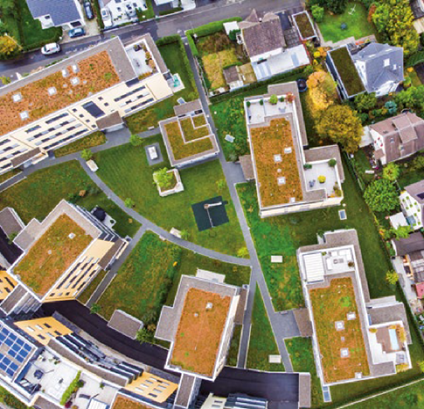
Together with partner companies, the Federal Environment Agency (UBA) is developing an innovative monitoring system for green roofs in Germany. High-resolution satellite data and machine learning (ML) methods are being used to create an indicator for green roofs - an important measure for adapting to climate change in urban areas. This indicator is part of the national climate change monitoring programme as part of the German Strategy for Adaptation to Climate Change (DAS).
"For us, cloud environments such as CODE-DE offer interesting sandbox properties that enable the flexible development of end-to-end earth observation applications. Above all, freely configurable virtual machines (Linux) and the ability to use S3 buckets play key roles here."
Project management and partners
As part of an in-house research project, the indicator is currently being further developed and operationalised by the Umweltbundesamt (UBA), KomPass - Kompetenzzentrum Klimafolgen und -anpassung (Federal Environment Agency, KomPass - Competence Centre for Climate Impacts and Adaptation) on the basis of the DASIF project.
Partners involved in the DASIF project:
- Brockmann-Consult GmbH
- Christian-Albrechts-Universität zu Kiel
Use of CODE-DE
The use of CODE-DE is essential for the project, as the platform provides powerful cloud and computing resources for processing large volumes of earth observation data.
Main reasons for using CODE-DE:
- Access to high-resolution Planet Basemaps
- Use of virtual machines for the development and scaling of ML workflows
- Storage and provision of large amounts of data via S3 buckets
Aim of the project
The aim of the project is to develop an improved monitoring system for green roofs as a climate adaptation measure.
Added value
- Identification of green roof areas on the basis of satellite images, as a cost-effective alternative to in-situ surveys
- If possible, nationwide and multi-year recording of green roofs, which is a novelty, as there is no nationwide data set to date
- Provision of a standardised and aggregated indicator for national climate change monitoring as part of the German Strategy for Adaptation to Climate Change (DAS)
Target customers of the expected results:
- Public authorities - integration into reporting on climate change adaptation and planning and support for green roof promotion programmes
- Research institutions - expansion of environmental and climate studies
Use of CODE-DE in the project
Period: Since January 2024 - ongoing until 2026
Virtual resources: Medium to large contingent
CODE-DE use for:
- Data research & download
- EO and geodata pre- and post-processing
- Development of ML methods
- Classification of EO image data
- Training, Validerung und Inferenz von ML-Modellen
- Bereitstellung von Ergebnissen für DAS-Monitoringberichte am UBA
Data used:
- High-resolution commercial EO data from Planet Labs (multispectral 8-band basemaps)
- Building model data (LoD2)
- Reference data sets from green roof mapping
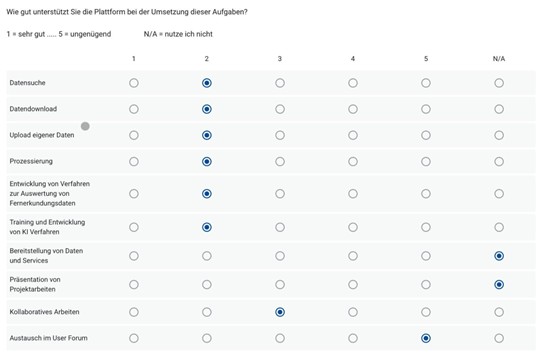
Cloud services used:
- Virtual machines (Linux)
- S3 buckets for data storage
- JupyterLab for workflow prototyping and data analysis
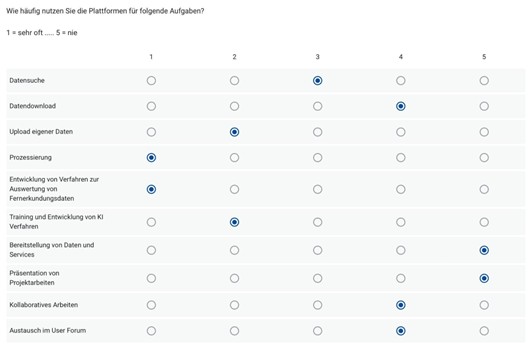
Advantages of using the cloud:
One of the biggest plus points for the project is the high flexibility and scalability of the computing resources. Thanks to the ability to configure and scale virtual machines as required, the project team can adjust the necessary computing power as required without having to invest in expensive hardware. The cloud also enables efficient storage of large amounts of data via S3 buckets, which ensures data availability and security. Collaboration with partners is also made considerably easier thanks to centralised data storage and easy access to the cloud environment.
CODE-DE Community & future use
Data sharing for other users: Possible after completion of the project
Testing options for external users: Planned for the later project phase
Results & next steps
- An initial survey of green roof areas for 2020 was compiled as part of the DASIF project, aggregated for15 major German cities (see Dashboard: DASIF Project)
- A prototype of the EO-based ML workflow, including pre- and post-processing of the EO and geodata, is currently being developed
- Work is also currently underway to validate the ML approach for the automated detection of green roof areas with multi-year reference data
Next steps:
The plan for the coming months is to finalise and validate the machine learning model by integrating additional reference data from other cities. A further step is to scale up the approach as far as possible across Germany to record green roof areas over several years. Finally, the project team will process the results in order to feed them into the indicator database and the UBA Data Cube so that they can be included in the federal government's DAS monitoring report.
Contact person:
Umweltbundesamt (UBA), KomPass - Kompetenzzentrum Klimafolgen und -anpassung (Federal Environment Agency, KomPass - Competence Centre for Climate Impacts and Adaptation)
Further links:
Kuhwald, K., Oppelt, N., Scholze, J., Stelzer, K., 2024. Operationalisierung von DAS-Indikatoren mit Fernerkundungsdaten (Schlussbericht No. 50/2024), Climate Change. Umweltbundesamt (UBA).
Operationalisierung von DAS-Indikatoren mit Fernerkundungsdaten (DASIF)
van Rüth, P., Schönthaler, K., von Andrian-Werburg, S., Wolf, M., Gabriel, M., 2023. Monitoringbericht 2023. zur Deutschen Anpassungsstrategie an den Klimawandel, Bericht der Interministeriellen Arbeitsgruppe Anpassungsstrategie der Bundesregierung. Umweltbundesamt (UBA).
Monitoringbericht 2023 zur Deutschen Anpassungsstrategie an den Klimawandel
Project image: © Heiner / stock.adobe.com